|
|
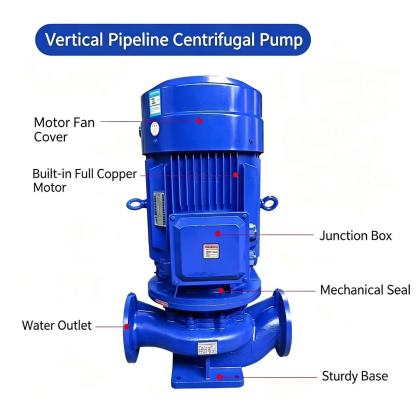
ISG Vertical Pipeline Centrifugal Pump cast iron pump bodyISG Vertical Pipeline Centrifugal Pump Cast Iron Pump Body: Material Science, Casting Quality, and What Engineers Need to InspectThe pump body of an ISG vertical pipeline centrifugal pump is the structural backbone of the entire machine. It holds the impeller in alignment with the volute, it contains the hydraulic pressure generated by rotation, it supports the bearing housing, and it transfers vibration and thermal expansion to the piping system. When that body is cast iron — and for the vast majority of ISG units in general water service, it is — the quality of the casting is not a secondary concern. It is the primary determinant of whether the pump lasts five years or twenty. Most ISG pumps in the DN40 to DN200 range use gray cast iron for the body. Some larger or higher-pressure variants use ductile iron. A few specialty units use stainless steel or bronze, but those are exceptions. The choice of cast iron is deliberate — it is cheap, it casts well into complex shapes, it dampens vibration, and it resists the mild corrosion found in most municipal and industrial water systems. But cheap does not mean forgiving. A badly cast body will crack, leak, and warp in ways that no amount of maintenance can fix.
Why Gray Cast Iron Is the Standard Material for ISG Pump BodiesGray cast iron — typically graded as HT200, HT250, or GG20, GG25 under international standards — is the default material for ISG pump bodies because of one property above all others: the graphite flakes embedded in the microstructure. These flakes act as internal stress relievers. When the casting cools and shrinks, the graphite absorbs the strain that would otherwise create hot tears or cracking in the iron matrix. This makes gray cast iron one of the easiest engineering metals to cast into the complex internal geometry of a pump volute — the spiral passage that converts velocity energy into pressure energy. The thermal conductivity of gray cast iron is around 40 to 55 watts per meter-kelvin, roughly half that of steel but far higher than stainless steel. This matters because the pump body sits in contact with the pumped fluid and must dissipate heat from the bearings and from friction in the wear rings. A body that traps heat accelerates seal degradation and bearing lubricant breakdown. Cast iron breathes thermal energy away from the critical internal surfaces. Damping capacity is another advantage. Gray cast iron absorbs vibration energy roughly ten times better than steel. For an ISG pump mounted directly in a pipeline — where pipe vibration can feed back into the pump and pump vibration can feed back into the pipe — this damping reduces the amplitude of resonant responses. The pump body does not ring like a bell. It soaks up the energy. This is one reason ISG pumps tend to be quieter than comparable end-suction designs with steel casings. But gray cast iron has weaknesses that engineers must respect. It is brittle. It has almost no ductility — elongation at break is typically less than one percent. It cannot absorb impact. If a pump is dropped during installation, if it is subjected to water hammer, or if it freezes in a cold environment with water trapped inside, the body can crack. And once it cracks, repair is rarely cost-effective. The cast iron body is a replace-when-failed component, not a repair-and-reuse one. Ductile iron — graded GGG40, GGG50, or similar — addresses the brittleness problem. The graphite in ductile iron forms spheroids rather than flakes, giving the material tensile strength comparable to low-carbon steel while retaining good castability. Some ISG pump manufacturers use ductile iron for bodies in the DN150 and larger sizes, or for units rated above 16 bar, where the hydraulic pressure exerts higher hoop stress on the volute walls. The trade-off is higher cost and slightly lower damping capacity. For most standard water service applications, gray cast iron remains the practical choice. Corrosion resistance is adequate but not outstanding. Gray cast iron forms a passive film in neutral or slightly alkaline water — the kind found in most municipal supply systems — and resists uniform corrosion well. In acidic water, in water with high chloride content, or in systems where the fluid contains abrasive particles, the corrosion rate accelerates and the body thins from the inside. Engineers specifying ISG pumps for aggressive fluids must verify that the cast iron grade and any internal coating or lining are appropriate for the specific water chemistry. What to Look for When Inspecting a Cast Iron ISG Pump BodyQuality in a cast iron pump body is not visible from the outside. Two bodies can look identical on a shelf and perform completely differently in service. The differences are inside — in the casting structure, in the wall thickness uniformity, in the absence of defects that grow under cyclic loading. Porosity is the most common internal defect. Gas porosity appears as small, round voids scattered through the casting, usually near the thicker sections where the molten iron solidified last. These voids do not always cause immediate failure, but they reduce the effective wall thickness and create stress concentration points. Under hydraulic pressure cycling — every time the pump starts and stops, every time the discharge valve opens and closes — these voids can initiate cracks that propagate slowly through the wall. A body with visible porosity on a cut section should be rejected. For critical applications, radiographic or ultrasonic inspection of the casting is warranted, especially at the volute tongue area where stress is highest. Shrinkage cavities are larger, irregular voids that form when the molten iron does not feed properly into a section as it cools. These are more dangerous than gas porosity because they are larger and more irregular, creating sharp internal corners that act as crack starters. The volute passage, with its changing cross-section and spiral geometry, is particularly prone to shrinkage if the gating and risering in the mold are not designed correctly. A good foundry controls this through directional solidification — designing the mold so that the iron freezes from the thin sections toward the thick sections, feeding liquid metal into the shrinking volume as it solidifies. Cold shuts and misruns occur when two streams of molten iron meet but do not fuse properly, leaving a seam in the casting. In a pump body, a cold shut in the volute wall is a leak path. Under pressure, fluid can seep through the seam. Over time, the seam erodes and the leak worsens. Cold shuts are a foundry process failure — they should not appear in a properly produced casting, but they do, especially in smaller foundries with less process control. The machining surfaces tell a story. The bearing housing bore must be concentric with the volute centerline within tight tolerances — typically 0.02 to 0.05 millimeters total indicated runout. If the casting was warped during cooling or if the machining reference was off, the bearing bore will be eccentric. This forces the shaft off-center, which misaligns the impeller, increases wear ring clearance on one side, and generates radial load on the bearings. Check the bearing bore with a dial indicator after machining. Check it again after the pump has been in service for a year, because cast iron can creep under sustained load and the bore can slowly distort. Wall thickness at the volute tongue — the narrowest point between the impeller outlet and the volute spiral — is critical. This is where hydraulic pressure is highest and where the wall is thinnest. If the casting is thin here — below the design minimum, which depends on the pressure rating but is typically 8 to 12 millimeters for standard ISG units — the body will deform under pressure. Deformation changes the impeller-to-volute clearance, destroys hydraulic efficiency, and eventually causes the tongue to crack. A good foundry uses core prints and chill inserts to control wall thickness at this location. A bad one does not. How Cast Iron Body Properties Change Over the Life of an ISG PumpA cast iron pump body does not stay the same from day one to day ten thousand. It changes — slowly, but measurably — and those changes affect everything the pump does. Corrosion is the most obvious change. In neutral water with low dissolved oxygen, the corrosion rate of gray cast iron might be 0.1 millimeters per year or less. In aggressive water, it can be 0.5 millimeters per year or more. Over ten years, that is five millimeters of wall loss — enough to take a 12-millimeter volute tongue down to seven, which is below safe limits. Regular wall thickness measurement at accessible points — using ultrasonic thickness gauging through the casing flange or at drain plugs — is the only way to track this. Do not rely on visual inspection. Cast iron corrosion is often uniform and invisible until the wall is dangerously thin. Erosion is the second mechanism. If the pumped fluid contains sand, grit, or other abrasive particles — common in raw water, groundwater, and some industrial processes — the high-velocity zones inside the volute erode the cast iron. The erosion pattern is not random. It concentrates at the volute tongue, at the wear ring clearances, and at the impeller inlet. Over time, the volute geometry changes — the passage becomes wider, the tongue becomes blunt, the hydraulic efficiency drops. The pump draws more power to deliver the same flow. The motor works harder. The whole system degrades. This is not a body failure in the catastrophic sense. It is a slow performance death that nobody notices until the energy bill climbs or the pump cannot meet its rated head. Thermal cycling causes microstructural changes in cast iron that are subtle but real. Repeated heating and cooling — from startup, shutdown, seasonal temperature swings — causes the graphite flakes to shift slightly within the matrix. Over thousands of cycles, this can loosen the structure at stress concentration points like the volute tongue root or the flange bolt holes. Hairline cracks can initiate. These cracks are invisible from the outside until they reach the surface, at which point they may appear as rust streaks or seepage. For ISG pumps in environments with frequent starts and stops — pressure boosting systems, batch processes, irrigation cycles — thermal fatigue is a real design consideration. Some manufacturers address this by using ductile iron in the higher-stress areas even when the rest of the body is gray iron. Mechanical damage from improper handling is the one change that is entirely preventable. Cast iron is heavy and awkward. Dropping a pump body onto a concrete floor from a forklift, striking it with a pipe wrench during disassembly, or overtightening flange bolts can create cracks that are not immediately visible but will propagate under pressure. Always handle cast iron pump bodies with care — use lifting eyes, support the full weight, and never use the flange faces as bearing surfaces for levers or tools. The body is strong in compression but weak in tension and bending. Treat it accordingly. |