|
|
ISG Vertical Pipeline Centrifugal Pump JB/T53058 standard referenceISG Vertical Pipeline Centrifugal Pump JB/T53058 Standard Reference: What This Specification Actually CoversThe JB/T53058 standard sits at the intersection of Chinese mechanical industry regulation and the practical engineering of vertical inline centrifugal pumps. For anyone working with ISG vertical pipeline centrifugal pump installations in China, sourcing from Chinese manufacturers, or specifying equipment for projects governed by Chinese industrial codes, this document is not optional reading. It defines the technical requirements, test methods, inspection rules, and quality benchmarks that separate a compliant unit from one that simply looks right on a drawing. Understanding what JB/T53058 covers — and what it deliberately does not cover — is the foundation for making sound procurement and engineering decisions.
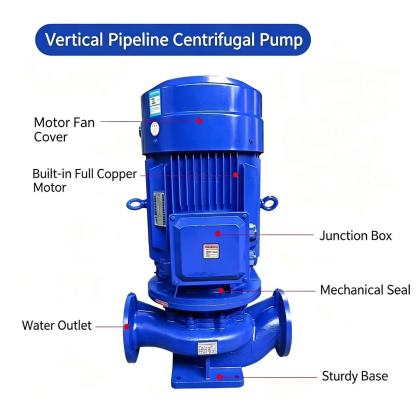
What JB/T53058 Actually Specifies for Vertical Pipeline PumpsJB/T53058 is a machinery industry standard issued under the Chinese JB/T classification system, which governs mechanical industry technical conditions. The full title references vertical pipeline centrifugal pumps, and it applies specifically to the ISG-type configuration — that is, single-stage, single-suction, vertical inline units where the motor sits directly above the pump casing and both share a common vertical axis. The standard lays out dimensional requirements for flange connections, overall pump height, inlet and outlet positioning, and the physical envelope the unit must fit within. These are not vague guidelines. They specify nominal diameters ranging from DN25 to DN300 (and in some revisions up to DN400), pressure ratings typically tied to PN10 or PN16 flange classes, and the center-to-center distances between suction and discharge flanges that must be maintained for interchangeability in pipe systems. Material requirements form another major section. The standard references which castings are acceptable for pump casings, impellers, and pump covers — typically grey cast iron (HT200 or HT250), ductile iron, or stainless steel grades depending on the fluid service. It does not specify exact alloy compositions but rather points to the relevant Chinese material standards (GB standards) that define chemical composition and mechanical properties. For impellers, the standard demands minimum tensile strength and hardness values after casting and machining, and it requires static balance testing before the impeller is assembled into the casing. Assembly tolerances receive detailed attention. Running clearance between impeller and wear ring, shaft runout limits, mechanical seal chamber concentricity, and bearing housing bore dimensions all have numerical tolerances listed in the document. These numbers matter because an ISG pump that is assembled loose will vibrate, leak, and fail seals prematurely. An ISG pump assembled too tight will bind at thermal expansion, seize the shaft, and crack the casing when the motor heats up during operation. The standard also covers the motor integration. Since the ISG pump uses a vertically mounted motor bolted directly to the pump head, JB/T53058 references the motor's mounting flange dimensions, the coupling between motor shaft and pump shaft (typically a rigid coupling or a short flexible coupling in smaller sizes), and the alignment tolerances that must be achieved at the factory before the unit ships. How JB/T53058 Relates to Testing and Inspection ProtocolsA standard that only defines dimensions and materials but says nothing about how to verify compliance is useless on the factory floor. JB/T53058 addresses this with a dedicated section on test methods and inspection rules. Hydrostatic pressure testing is mandatory. Every assembled ISG pump must undergo a shell test at 1.5 times the rated working pressure, held for a specified duration with no visible leakage or permanent deformation. This is not a suggestion — it is a pass-fail criterion. Units that leak during shell test do not leave the factory. Performance testing follows a defined procedure. The pump is run on a test stand with calibrated flow and pressure instrumentation. The test measures flow rate, head, power input, and efficiency at multiple points across the curve — typically at shut-off, at the best efficiency point, and at one or two higher flow points. The measured values must fall within the tolerances specified in the standard relative to the guaranteed values on the nameplate. For an ISG pump rated at 50 cubic meters per hour and 32 meters head, the actual test result might need to be within plus or minus 5 percent of those numbers. The standard defines what that tolerance band is and how many test runs are required. NPSH testing is included, though it is less commonly performed on every unit in production. For larger ISG pumps or units destined for critical service, the standard references the method for determining NPSHr by gradually reducing suction pressure until a 3 percent head drop is observed. This is the same fundamental method used globally, but JB/T53058 codifies it in a way that Chinese inspection bodies and third-party certifiers can reference. Vibration and noise limits are specified as well. The standard sets maximum vibration velocity values for the bearing housing — typically in the range of 4.5 mm/s for smaller units and 7.1 mm/s for larger ones, measured in three orthogonal directions. Noise levels are referenced in decibels measured at one meter from the pump in a semi-anechoic or specified acoustic environment. These limits keep ISG pumps from being shipped with bent shafts, unbalanced impellers, or resonating casings that would make a mechanical room unbearable. Inspection rules define what gets checked on every unit versus what gets sampled. Dimensional checks and visual inspections are 100 percent. Hydrostatic test is 100 percent. Performance test may be done on a percentage of production — often 20 to 30 percent — with the remainder verified by dimensional and visual means unless the customer specifies full testing. The standard leaves room for this, but it also states that any unit selected for performance testing must meet the curve requirements or the entire batch is subject to re-evaluation. Where JB/T53058 Fits Within the Broader Regulatory LandscapeJB/T53058 does not exist in isolation. It is one standard in a web of Chinese industrial regulations that collectively govern how ISG vertical pipeline pumps are designed, manufactured, and sold. The standard cross-references GB/T5657 for centrifugal pump performance testing methods, which provides the detailed methodology for how flow, head, and efficiency measurements are to be conducted on a test stand. Without GB/T5657, the performance section of JB/T53058 would have no technical backbone. Similarly, material specifications point back to GB standards for cast iron, stainless steel, and carbon steel that define what the pump components are made from. For export or international projects, JB/T53058 is not automatically recognized outside China. It does not carry the weight of ISO 9906 or EN 12723, which are the performance testing standards used in Europe. A Chinese manufacturer producing ISG pumps to JB/T53058 can still meet international standards if they choose to — but they are not required to unless the contract demands it. This distinction matters enormously for procurement. A buyer who assumes JB/T53058 compliance means ISO-level quality is making an assumption that the standard itself does not support. The standard also intersects with pressure equipment directives within China. If an ISG pump is used in a system that falls under Chinese pressure vessel or pressure piping regulations — for example, in a boiler feed system or a high-pressure chemical transfer line — the pump itself may not be classified as a pressure vessel, but the system it serves is. JB/T53058 does not address system-level compliance. It addresses the pump as a mechanical product. The system integrator must handle the rest. One practical note that engineers often miss: JB/T53058 has been revised over the years. Older versions exist alongside current ones, and some manufacturers still quote compliance with earlier revisions that have looser tolerances or omit requirements added in later updates. When specifying an ISG pump under this standard, always confirm the specific revision year — typically the most recent version available — and require the manufacturer to state that revision on the inspection certificate. A certificate that says "compliant with JB/T53058" without a year is functionally meaningless. Practical Implications for Engineers and SpecifiersKnowing the standard exists is one thing. Using it correctly in real projects is another. When writing a technical specification for ISG vertical pipeline pumps, reference JB/T53058 by its full designation and revision year. Do not just say "JB/T53058 compliant." State which sections apply — dimensions, materials, testing, inspection — and specify whether full performance testing or sampling is acceptable. If the application involves hazardous fluids, high temperatures, or corrosive media, the standard's base requirements may not be sufficient on their own, and you will need to layer additional material or testing requirements on top. During factory acceptance testing, the standard gives you the legal and technical basis to witness or require specific tests. If the manufacturer skips the hydrostatic test or runs the performance test on a unit that was not randomly selected from the batch, you have a documented basis to reject the shipment. The standard is your leverage — but only if you actually know what it says and what it requires. For maintenance engineers who service ISG pumps in Chinese industrial facilities, JB/T53058 provides the original equipment benchmarks. When a pump fails and you need to evaluate whether a replacement impeller or casing is within tolerance, the dimensional and material requirements in the standard are the reference point. Ordering a non-standard replacement without checking those tolerances is how you end up with a unit that vibrates at 1450 rpm and fails its seal in six months. |