|
|
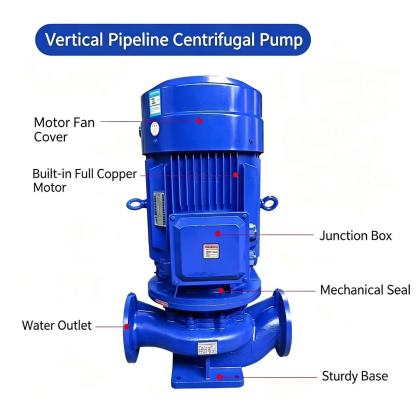
ISG Vertical Pipeline Centrifugal Pump compact footprint structureISG Vertical Pipeline Centrifugal Pump: The Engineering Behind Its Compact Footprint StructureWalk into almost any modern mechanical room and you will see them — tall, narrow pumps standing upright in the piping runs, taking up barely more floor space than the pipe itself. The ISG vertical pipeline centrifugal pump owes its ubiquity to a structural decision that seems obvious in hindsight: stack the motor above the hydraulic end and align the suction and discharge on a single axis. What that decision delivers is not just a smaller pump but a fundamentally different relationship between the equipment and the building around it.
A conventional horizontal end-suction pump lays its motor and pump body side by side. The footprint is wide, the baseplate is heavy, and the piping has to turn 90 degrees at both the suction and discharge to connect. In a plant room where every square meter costs money in construction, HVAC routing, and structural loading, that sprawl adds up. The vertical pipeline approach collapses the same hydraulic performance into a footprint roughly equal to the casing diameter. The motor goes up, not out, and the piping passes straight through. The difference in occupied floor area can be 60 percent or more compared with an equivalent horizontal unit, and in retrofit situations where space was never designed for pump replacement, that difference is often the difference between a job that is possible and one that is not. The Vertical Stack: Motor, Shaft, and Casing as One Structural ColumnThe compact footprint is achieved by treating the pump as a vertical column rather than a horizontal assembly. The motor sits on top, its shaft extending downward through a coupling or directly into the pump casing. The impeller keys onto that shaft, and the volute casing wraps around it at the bottom. Inlet and outlet flanges project horizontally from the casing on opposite sides, sharing the same centerline and diameter. The entire unit is, in effect, a section of pipe with a motor standing on it. This stacked arrangement eliminates the separate pump bearing frame found on horizontal pumps. The motor bearings carry the radial and axial loads, and the motor frame itself becomes part of the pump's structural body. That removes a significant amount of hardware — no bearing housing, no separate lubrication system, no coupling guard spanning a gap between two machines. The axial length of the rotating assembly is short, which improves shaft stiffness and reduces deflection at the seal faces. A stiffer shaft means the mechanical seal runs closer to its design alignment, which extends seal life and reduces leakage over time. The trade-off is that the motor must be specified to handle pump-side loads. Not every motor is suitable. The bearings need sufficient thrust capacity to absorb the axial force generated by the impeller, and the motor frame must be rigid enough to resist the bending moments introduced by piping loads. Manufacturers address this by using extended motor shafts, reinforced end bells, and bearing arrangements rated for pump duty. When the motor is properly selected, the close-coupled vertical design is robust; when a generic motor is substituted, bearing failures and shaft deflection follow. How the Same-Centerline Ports Shrink the Installation EnvelopeThe vertical stack handles height, but the real footprint savings come from the coaxial inlet and outlet. On a horizontal pump, the suction comes in perpendicular to the shaft and the discharge exits perpendicular to that, requiring elbows on both sides and a wide clearance zone around the pump for piping routing. On an ISG unit, the fluid enters one side and exits the opposite side in a straight line. The pump is, hydraulically speaking, a section of pipe that adds pressure. This means the piping does not have to bend around the pump. A straight run of pipe is cut, the pump is inserted, and the flanges are bolted. There are no suction elbows to induce pre-swirl into the impeller, no discharge elbows to add turbulence, and no offset piping to create misalignment stress. The installation envelope is essentially the pump's own width plus a small service clearance on one side. In a parallel pump arrangement — common in HVAC plants where duty and standby units are installed — multiple ISG pumps can be lined up in a row with minimal spacing between them, because each unit only needs access from above for motor removal rather than from all four sides. The straight-through flow path also simplifies valve placement. Isolation valves, check valves, and strainers can all sit in the same horizontal run as the pump, creating a neat, linear assembly that is easy to support and easy to insulate. Contrast this with a horizontal pump installation, where the discharge elbow often dictates where the check valve can go and where the pressure gauge must be mounted. The linear layout of a vertical pipeline pump installation is not just cleaner visually; it reduces the number of joints, the number of potential leak points, and the total material cost of the piping package. Structural Implications for Buildings and Equipment RoomsA compact footprint is not only about saving space on a drawing. It changes how the building is designed. A horizontal pump with its baseplate and concrete inertia block imposes a significant concentrated load on the floor structure. The inertia block alone can weigh hundreds of kilograms, and it requires a thickened slab or a structural pedestal. A vertical pipeline pump, by contrast, is often supported by the piping or by a small foot mount directly to the floor. The structural loading is lighter, the foundation work is minimal, and in many cases the pump can be installed on a standard floor slab without special reinforcement. This matters in existing buildings. When a facility manager needs to add pumping capacity or replace an obsolete unit, the structural capacity of the floor is often the limiting factor. A pump that can be placed without a new inertia base, without floor penetration, and without major structural modification opens up retrofit options that would otherwise be uneconomical. Roof-mounted installations, interstitial mechanical floors, and equipment platforms all benefit from the reduced weight and footprint of the vertical pipeline design. The vertical orientation also affects how vibration is managed. A tall, narrow pump has a different center of gravity than a wide, low horizontal unit, and its natural frequency can be closer to operating speed if not properly isolated. Spring isolators or inertia pads may be needed for larger units, especially where the pump is mounted on a floor that is sensitive to vibration transmission. The key is to isolate the pump from the structure while still allowing the piping to flex — rigidly bolting a vibrating pump to the floor and rigidly connecting it to the piping simply transfers vibration into the building and stress into the pump casing. Serviceability Within a Compact EnvelopeA compact footprint would be a liability if it made the pump impossible to maintain. The ISG design addresses this by making the rotating assembly removable from above. The motor lifts off, the shaft and impeller come out, and the casing stays in the piping line. This is the opposite of a horizontal back-pull-out pump, where the rotating assembly comes out the back and the piping stays in place — but both approaches achieve the same goal: no need to disconnect the suction and discharge piping for routine service. The vertical pull-out does require overhead clearance. In a cramped mechanical room, the distance from the top of the motor to the ceiling must be enough to lift the motor free. This is a dimension that is easy to overlook during layout and painful to discover during the first seal replacement. Good design practice leaves at least the motor height plus a working margin above the pump. Where ceiling height is genuinely constrained, some designs use a side-access configuration or a split coupling that allows the motor to be moved sideways rather than lifted, but these are exceptions rather than the norm. The mechanical seal itself is positioned between the motor and the impeller, accessible once the motor is removed. Because the seal runs on a vertical shaft, gravity works in favor of keeping the seal faces clean — debris tends to fall away from the seal faces rather than settle between them. This is a subtle but real advantage in services where the fluid carries small particles. The vertical orientation also means that when the pump is shut down, any leakage at the seal drains downward rather than pooling around the seal faces, which reduces the risk of corrosion and sticking during idle periods. Design Trade-offs: What Compactness CostsNo design is free, and the compact vertical structure has real limitations. The most significant is motor cooling. A vertical motor with its fan at the top relies on airflow over the frame, and if the pump is installed in a confined space with poor ventilation, the motor runs hot. Elevated operating temperature accelerates insulation degradation and bearing grease breakdown, shortening motor life. Ventilation around the motor — not just around the pump — is a design requirement that is frequently underestimated. The close-coupled shaft arrangement means the motor and pump are not independently serviceable. When the motor fails, the pump is down; when the seal fails, the motor must be removed. There is no option to swap a motor while leaving the pump in place the way there is with a separately coupled horizontal pump. For critical services, this is why standby pumps or modular arrangements are common — the compact footprint makes it affordable to install a spare unit in the space that a single horizontal pump would have occupied. NPSH behavior also deserves attention. The vertical casing and the U-turn flow path inside the volute create a slightly different suction geometry than a horizontal end-suction pump. The available NPSH at the impeller eye can be affected by air accumulation in the top of the casing, and proper venting before startup is essential. In systems where the suction pressure is marginal, the pipeline pump's suction characteristics should be verified against the system curve rather than assumed from a horizontal pump's performance. The compact footprint of the ISG vertical pipeline centrifugal pump is the product of deliberate structural choices — stacking motor and hydraulics, aligning the ports, and using the motor as a load-bearing component. Those choices deliver real savings in space, weight, piping, and installation time, but they also impose specific requirements for motor selection, overhead clearance, ventilation, and service access. Understanding both sides of that equation is what allows an engineer to specify the pump with confidence and an operator to keep it running for decades. |