|
|
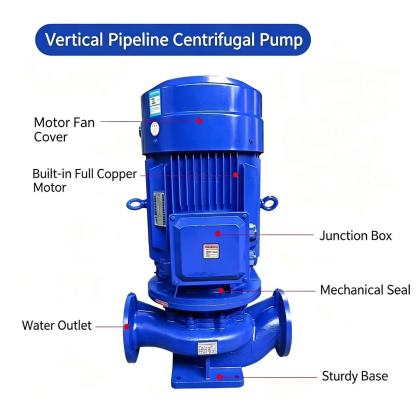
ISG Vertical Pipeline Centrifugal Pump anti-corrosion material optionISG Vertical Pipeline Centrifugal Pump: Anti-Corrosion Material Options and Selection GuidanceA pump that moves clean water at ambient temperature is one thing. A pump that handles seawater, mildly acidic process fluids, chlorinated HVAC water, or chemical-laden wastewater is something else entirely. The ISG vertical pipeline centrifugal pump is available in a range of material configurations precisely because corrosion is not a single problem — it is a family of failure modes, each demanding a different metallurgical or coating response. Selecting the right materials is not an upgrade to be tacked on at the end of a specification; it is the foundation of whether the pump lasts years or months.
Corrosion in centrifugal pumps takes several forms, and they do not always announce themselves loudly. Uniform corrosion thins a casing wall gradually over years. Pitting corrosion bores tiny holes through a surface in weeks. Galvanic corrosion eats away at the less noble metal wherever two dissimilar materials meet. Cavitation damage, while not strictly corrosion, accelerates it by stripping protective oxide layers and exposing fresh metal. Erosion-corrosion combines fluid velocity with chemical attack, wearing away impeller vanes and volute cutwaters. A material that resists one mechanism may fail catastrophically against another, which is why material selection always begins with a clear picture of the fluid, its temperature, its contaminants, and the operating conditions. Understanding the Corrosion EnvironmentBefore choosing a material, the engineer needs to characterize the fluid. pH is the most obvious parameter, but it is rarely sufficient. A fluid with a neutral pH can still be highly corrosive if it contains dissolved oxygen, chlorides, sulfides, or abrasive suspended solids. Seawater, for example, is roughly neutral but contains around 35,000 parts per million of chloride, which breaks down the passive oxide layer on stainless steel and causes pitting. Hot water is more corrosive than cold water because reaction rates roughly double with every 10-degree Celsius rise. And a fluid that is benign at design temperature may become aggressive during startup, shutdown, or abnormal operating conditions when temperatures or concentrations spike. Dissolved gases deserve special attention. Oxygen in water accelerates corrosion by serving as a cathodic reactant, and carbon dioxide forms carbonic acid that attacks iron and steel. Hydrogen sulfide, common in sewage and some industrial processes, causes sulfide stress cracking in hardened steels and attacks copper alloys. Even clean drinking water can become corrosive if it is stripped of minerals by reverse osmosis or distillation — ultra-pure water is surprisingly aggressive because it lacks the dissolved ions that form protective scales on metal surfaces. The velocity of the fluid inside the pump also matters. At low velocities, sediment can settle and create under-deposit corrosion, where the area beneath the deposit becomes oxygen-starved and anodic relative to the surrounding surface. At high velocities, the protective oxide or scale layer is stripped away, exposing fresh metal and causing erosion-corrosion. Every material has a practical velocity limit, and exceeding it — especially at the impeller tip, where local velocities are highest — turns a normally durable material into a consumable. Casing and Body MaterialsThe pump casing is the largest wetted component and the one most exposed to the full pressure and temperature of the system. Standard ISG pumps use cast iron casings, which are inexpensive, rigid, and perfectly adequate for clean, treated water at moderate temperatures. Cast iron forms a graphite-rich surface layer as it corrodes, which can actually provide some protection in neutral waters — but in acidic or alkaline fluids, that layer offers little resistance, and the iron matrix dissolves away. For mildly corrosive service, bronze casings are a common step up. Tin bronzes and aluminum bronzes resist corrosion in seawater, brines, and many non-oxidizing acids. Aluminum bronze, in particular, forms a tough aluminum oxide film that resists both corrosion and erosion, making it a favorite for marine and offshore pumping. Bronze is also less prone to galling than stainless steel, which matters at wear ring interfaces. The downsides are weight, cost, and strength — bronze is not as strong as cast iron or steel, so casings may need thicker walls for high-pressure service. Stainless steel casings represent the standard upgrade for corrosive or high-purity service. Austenitic grades such as 304 and 316 are the most common. Grade 304 handles a wide range of organic and inorganic chemicals but is vulnerable to chloride pitting. Grade 316 adds molybdenum, which significantly improves chloride resistance and makes it suitable for brackish water, paper mill environments, and food-processing applications where chlorinated cleaning solutions are used. For more aggressive chloride environments — seawater, desalination brines, pulp mill bleach plants — duplex stainless steels or super-austenitic grades are needed. Duplex alloys combine austenitic and ferritic microstructures, offering roughly twice the yield strength of 316 along with superior pitting and crevice corrosion resistance. Cast stainless steel is not the same as wrought stainless steel. The casting process introduces porosity, segregation, and sigma phase formation that can reduce corrosion resistance compared with the wrought equivalent. Specifying a cast grade such as CF8M (the cast equivalent of 316) requires attention to heat treatment and quality control, because a poorly solution-annealed casting can suffer from intergranular corrosion at grain boundaries. For critical services, the casting should be solution-annealed after pouring and, where possible, pickled and passivated to restore the chromium oxide surface. Impeller, Shaft, and Wear Ring MaterialsThe impeller sees the highest velocities and the most intense hydraulic forces in the pump, so its material must resist both corrosion and erosion. Cast iron impellers are standard for clean water, but in corrosive service they are typically upgraded to bronze, stainless steel, or in some cases engineered plastics and composites. Bronze impellers perform well in seawater and are often paired with bronze casings to avoid galvanic issues. Stainless steel impellers in 316 or duplex grades handle a broader chemical range and can be cast or, for small sizes, investment-cast for smoother surface finishes that improve hydraulic efficiency. The shaft is a critical component because a shaft failure is catastrophic — it sends the impeller through the casing. Standard shafts are carbon steel or 400-series stainless steel, both of which are strong but vulnerable to corrosion. In corrosive service, the shaft is typically upgraded to 316 stainless steel, duplex, or higher alloys. The shaft also passes through the mechanical seal, and any corrosion or pitting at the seal running surface destroys seal performance. Some designs use a shaft sleeve — a replaceable cylinder of corrosion-resistant material — over the shaft at the seal location, so that seal wear and corrosion affect the sleeve rather than the shaft itself. The sleeve is cheaper to replace than the shaft, and it allows a less expensive shaft material to be used in moderately corrosive service. Wear rings are the renewable interfaces between the impeller and the casing that control internal recirculation. In corrosive service, the material pairing at the wear rings matters because two similar metals can gall and seize when they contact. A common strategy is to use dissimilar materials — for example, a stainless steel casing wear ring paired with a bronze or composite impeller wear ring. Composite wear rings made from filled PTFE, carbon-fiber-reinforced polymers, or silicon carbide offer excellent corrosion resistance across a wide pH range and eliminate galling entirely, though they have temperature and pressure limits that must be respected. Mechanical Seal and Elastomer CompatibilityThe mechanical seal is often the first component to fail in a corrosive application, and its material selection is at least as important as the casing material. The seal faces — the two lapped surfaces that rotate against each other — are available in several material pairings. Carbon against ceramic is the standard for clean water and is inexpensive, but ceramic can crack under thermal shock and carbon is not suitable for services where the fluid lacks lubricity. Silicon carbide against silicon carbide is the preferred pairing for corrosive, abrasive, or high-temperature service because silicon carbide is chemically inert, extremely hard, and dimensionally stable. Silicon carbide against carbon is a compromise that offers good corrosion resistance at a lower cost. The elastomers in the seal — the O-rings, gaskets, and secondary seals — are equally critical. Nitrile (Buna-N) handles water, oils, and many hydrocarbons but fails in ozone, strong acids, and polar solvents. EPDM resists hot water, steam, ketones, and many acids but is incompatible with petroleum-based fluids. Viton (fluorocarbon) handles a broad range of chemicals and high temperatures but is expensive and can be attacked by steam and certain solvents. Perfluoroelastomers offer near-universal chemical resistance but at a significant cost premium. Selecting the wrong elastomer is a common and expensive mistake: the seal may look fine on the outside while the O-ring has turned to mush inside, causing sudden leakage. The seal environment also matters. In services where the fluid crystallizes or contains solids, a standard seal may suffer from face clogging and abrasive wear. Flush plans that inject clean fluid into the seal chamber, or double-seal arrangements with a barrier fluid, isolate the seal faces from the process fluid. These are not material choices per se, but they extend the life of whatever seal material is selected and are often the difference between a seal that lasts weeks and one that lasts years. Coatings and Linings as Alternatives to Full Alloy ConstructionWhen full stainless steel or duplex construction is not feasible, coatings and linings can provide corrosion protection at a lower cost. Epoxy coatings applied to the inside of cast iron casings resist corrosion from many waters and mild chemicals, but they are vulnerable to mechanical damage during installation and to under-film corrosion if a chip or scratch exposes the base metal. Fusion-bonded epoxy provides a harder, more durable surface and is commonly used in water and wastewater pumps. Rubber linings — natural rubber, neoprene, butyl, or EPDM — offer excellent resistance to abrasion and many chemicals, but they are limited to moderate temperatures and can be damaged by sharp solids or by improper installation. Glass lining (enamel) provides an inert, smooth surface that resists a wide range of chemicals, including strong acids, but it is brittle and can crack under thermal shock or mechanical impact. It is more common in chemical process pumps than in standard ISG pipeline pumps, but it is available for specialized corrosive services. The key limitation of any coating or lining is that it must remain intact. Once breached, corrosion can spread beneath the lining and cause catastrophic failure without visible warning. Regular inspection — including borescopic examination of the casing interior — is essential for lined pumps in corrosive service. Cathodic protection is another option, primarily for pumps handling conductive fluids such as seawater or brackish water. Sacrificial anodes of zinc or magnesium can be mounted inside the casing to protect the wetted surfaces, though their effectiveness depends on fluid conductivity and the anode-to-surface-area ratio. Impressed-current systems are more complex but offer longer protection life. Cathodic protection is rarely used alone; it is typically combined with corrosion-resistant alloys or coatings as part of a layered defense strategy. Material Selection: Matching the Fluid to the MetalThe process of selecting materials should be systematic rather than habitual. Start with the fluid composition — not just the primary chemical but the contaminants, dissolved gases, and pH range. Consider the temperature range, including abnormal conditions. Evaluate the fluid velocity and the presence of suspended solids. Then, for each wetted component, choose a material that resists the dominant corrosion mechanism within that component's specific environment. It is also important to consider galvanic compatibility between materials. When two dissimilar metals are immersed in a conductive fluid, the less noble (more anodic) metal corrodes preferentially. A stainless steel casing with a bronze impeller, for example, will cause the bronze to corrode sacrificially — which may be acceptable if the bronze component is inexpensive and replaceable, but unacceptable if it is the casing. In general, all wetted components in a corrosive pump should be as close as possible on the galvanic series, or the anodic component should be designed to be sacrificial and easily replaced. Temperature cycling can also cause problems that steady-state analysis misses. A material that is resistant at operating temperature may crack or become brittle during cold startup. Thermal expansion differences between a metal casing and a lining or coating can cause delamination. And some materials — particularly duplex stainless steels — are susceptible to embrittlement if held in certain temperature ranges for extended periods, which can occur during abnormal operation or during heat treatment. The final consideration is availability and lead time. Standard cast iron and 316 stainless steel components are usually stocked. Duplex and super-austenitic grades may require custom casting and longer delivery. If the application truly demands a high-performance alloy, that lead time should be built into the project schedule rather than discovered after the order is placed. Material selection for corrosion is ultimately a balancing act between performance, reliability, cost, and practicality — and getting it right means the pump serves for decades rather than becoming a recurring maintenance problem. |