|
|
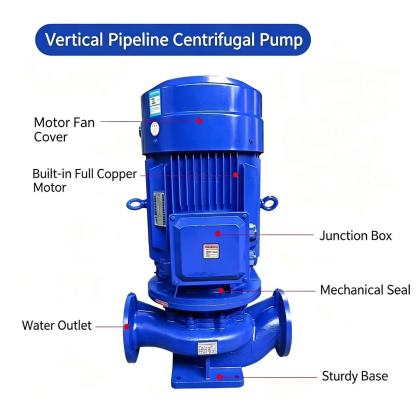
ISG Vertical Pipeline Centrifugal Pump bronze impeller configurationISG Vertical Pipeline Centrifugal Pump: Bronze Impeller Configuration and Hydraulic DesignInside every centrifugal pump, the impeller is the component that actually does the work. It takes rotational energy from the motor and transfers it to the fluid, accelerating it outward and building pressure. In an ISG vertical pipeline centrifugal pump, the impeller sits at the bottom of the vertical shaft, inside the volute casing, and its design — its material, its geometry, its vane configuration — determines nearly everything about how the pump performs. Bronze has been a preferred impeller material for over a century, and for good reason: it casts cleanly, resists corrosion in many fluids, and machines to tight tolerances. But "bronze" is not a single material, and an impeller is not just a spinning disk. The configuration of a bronze impeller involves choices in alloy, vane geometry, shroud design, and hub construction that together define the pump's efficiency, NPSH behavior, and service life.
The decision to use a bronze impeller is usually driven by the fluid. Clean, cold water can be handled perfectly well by cast iron, but seawater, brackish water, brines, mildly acidic solutions, and many process chemicals will attack cast iron rapidly. Bronze — particularly the tin and aluminum varieties — forms protective oxide films that resist these environments. Beyond corrosion resistance, bronze offers good castability, which matters because impeller geometry is complex and difficult to machine from solid stock. It also has favorable anti-galling properties, which is important at the wear ring interface where the rotating impeller runs close to the stationary casing. Bronze Alloys Used in Impeller ConstructionNot all bronzes are the same, and the alloy chosen for an impeller depends on the service conditions. Tin bronzes, such as C93200 and C93700, are the traditional choice for water and general-purpose service. They contain roughly 5 to 10 percent tin along with small amounts of zinc and lead, which improve machinability and castability. Tin bronzes resist corrosion in freshwater, seawater, and many non-oxidizing acids, and they are relatively soft, which means they wear sacrificially rather than damaging the mating wear ring. The lead content, while beneficial for machinability, restricts their use in potable water applications in some jurisdictions, and it can be leached out in certain chemical environments. Aluminum bronzes, such as C95400 and C95800, are a different category. They contain 9 to 14 percent aluminum and often additions of iron, nickel, and manganese. The aluminum forms a hard, adherent oxide film on the surface that provides excellent resistance to corrosion and erosion — particularly in seawater and other chloride-containing fluids. Aluminum bronze is significantly stronger than tin bronze, which allows thinner section designs and higher operating speeds. It is the alloy of choice for marine pumps, desalination intake pumps, and any application where cavitation or erosion is a concern. The trade-off is that aluminum bronze is more difficult to cast and machine, and it is susceptible to dealuminification — a selective corrosion process that removes aluminum from the alloy — in certain high-temperature or low-oxygen environments. Manganese bronzes, such as C86300, are high-strength alloys used for large impellers or for pumps operating at high pressures and speeds. They contain manganese, iron, aluminum, and zinc, and they approach the strength of low-alloy steels while retaining good corrosion resistance. Manganese bronze impellers are common in large pipeline pumps and in services where the impeller must withstand high hydraulic loads. They are, however, more prone to selective phase corrosion in some environments, and they require careful heat treatment to achieve their full mechanical properties. Silicon bronzes and nickel-aluminum bronzes occupy specialty niches. Silicon bronze offers excellent corrosion resistance in acidic environments and is sometimes used in chemical processing pumps. Nickel-aluminum bronze (NAB), such as C95800, is the premium marine alloy — it combines the corrosion resistance of aluminum bronze with improved strength and cavitation resistance through nickel additions. NAB impellers are standard in naval and commercial marine pumps, where reliability in seawater is non-negotiable. Impeller Geometry: Closed, Semi-Open, and Open DesignsThe bronze impeller in an ISG pipeline pump is most commonly a closed (enclosed) design. A closed impeller has a front shroud and a back shroud that sandwich the vanes, creating fully enclosed flow channels from the impeller eye to the periphery. This design delivers the highest hydraulic efficiency because there is minimal leakage between the pressure side and suction side of the vanes. The closed configuration also provides structural rigidity, which is important for bronze impellers that may operate at high speeds. The trade-off is that closed impellers are more susceptible to clogging if the fluid contains stringy or fibrous solids, and they are more complex to cast because the internal vane geometry must be formed by cores. Semi-open impellers have a back shroud but no front shroud, leaving the vanes exposed on the suction side. This design is less efficient than a closed impeller because some fluid recirculates over the vane tips, but it is more resistant to clogging and can handle small amounts of suspended solids. Semi-open bronze impellers are sometimes used in wastewater and light slurry applications where a fully closed impeller would foul. The open vane tips also allow for adjustment — the impeller can be moved axially to reduce the clearance between the vane tips and the casing, restoring performance as wear occurs. Open impellers have neither shroud, consisting only of vanes attached to a central hub. They are the least efficient but the most clog-resistant, and they are rarely used in ISG pipeline pumps because these pumps are typically specified for clean or lightly contaminated fluids. Open impellers are more common in slurry and sewage pumps, where passing large solids is the primary requirement. Within the closed impeller, the vane configuration further defines performance. The number of vanes typically ranges from five to nine for a standard water pump. Fewer vanes (four to six) allow larger passageways and better solids handling but may create more flow pulsation. More vanes (seven to nine) provide smoother flow and better efficiency at the design point but reduce the maximum passage size. The vane exit angle — the angle at which the vane leaves the impeller periphery — is typically between 15 and 30 degrees for a standard centrifugal pump. A lower exit angle produces a flatter head-flow curve and lower power at shutoff, while a higher exit angle produces a steeper curve and higher efficiency at the design point but higher power consumption at low flow. The Impeller Eye and NPSH ConsiderationsThe impeller eye — the central inlet where fluid enters the rotating vanes — is a critical design parameter, especially in a vertical pipeline pump where the suction piping is in-line with the discharge. The eye diameter determines the inlet velocity and, consequently, the net positive suction head required (NPSHr). A larger eye reduces inlet velocity and lowers NPSHr, which helps prevent cavitation, but it also increases the front shroud diameter and can reduce efficiency by increasing the area over which leakage occurs. Bronze impellers designed for low-NPSH applications often use a larger eye diameter combined with special inlet vane geometry. The vanes may be extended forward into the eye (inducer-style vanes) or given a helical leading edge to reduce incidence losses at the inlet. These design features are particularly important in hot-water circulating systems, where the fluid is close to its vapor pressure and even a small NPSH margin can mean the difference between quiet operation and destructive cavitation. The eye also affects the pump's suction-specific speed, a dimensionless parameter that relates flow, speed, and NPSHr. Higher suction-specific speed impellers are more sensitive to operation away from the best efficiency point — they can experience recirculation at the inlet when operated at low flow, which causes cavitation-like damage even when the available NPSH appears adequate. Bronze's good cavitation resistance helps, but it cannot compensate for a fundamentally mismatched impeller design. The impeller eye and vane inlet geometry must be matched to the system's suction conditions, not just the design flow rate. Hub, Shaft Connection, and BalancingThe bronze impeller mounts to the shaft through a central hub. In a close-coupled ISG pump, the shaft is the motor's extended shaft, and the impeller is typically keyed to the shaft and secured with a nut or a set screw. The hub design must transmit the full motor torque to the impeller without slipping, and it must locate the impeller axially so that the wear ring clearances are correct. In vertical pumps, the impeller's weight acts downward on the shaft, and the hub must support that weight while also resisting the upward hydraulic thrust generated by the impeller during operation. The keyway is a potential stress raiser, and in bronze impellers — which are softer than steel — the keyway can deform under high torque or during a jam condition. Some designs use a taper fit with a key, where the impeller hub is bored to match a tapered shaft section and drawn up with a nut. The taper provides friction drive that supplements the key and reduces the likelihood of keyway damage. For larger impellers, a through-bolt or a threaded shaft end may be used instead of a key, with torque transmitted by the friction between the tapered hub and shaft. Balancing is essential for any rotating component, and bronze impellers are no exception. Because bronze is denser than cast iron, an unbalanced bronze impeller generates higher centrifugal forces at the same speed and eccentricity. Impellers are typically statically balanced after casting and machining by removing material from the back shroud or from designated balance pads. For high-speed or large-diameter impellers, dynamic balancing — which corrects couple imbalance as well as static imbalance — may be required. The balance quality grade specified for the impeller depends on the pump speed and application; a typical requirement is ISO 1940 Grade G6.3 or better for general-purpose pumps and G2.5 for high-speed or critical-service units. Casting defects in bronze impellers — porosity, shrinkage, inclusions — can affect both balance and structural integrity. X-ray or dye-penetrant inspection may be specified for critical-service impellers to detect subsurface porosity that could propagate under fatigue loading. The casting process itself matters: investment casting (lost-wax) produces smoother surfaces and tighter tolerances than sand casting, which improves hydraulic efficiency and reduces the need for extensive machining. For small to medium impellers, investment casting is increasingly common; for very large impellers, sand casting remains the practical choice. Wear Ring Configuration and Material PairingAt the periphery of a closed impeller, the front and back shrouds run close to the casing, separated by a narrow clearance. This clearance is controlled by wear rings — renewable rings that are press-fitted or screwed into the casing and, in some designs, onto the impeller. The purpose of the wear rings is to minimize internal recirculation from the high-pressure periphery back to the low-pressure eye, while providing a sacrificial surface that can be replaced when clearance increases due to wear. In a bronze impeller configuration, the impeller wear ring (if fitted) is typically bronze, and the casing wear ring is a dissimilar material — often cast iron, stainless steel, or a composite. The dissimilar pairing prevents galling, which is the adhesive wear that occurs when two similar metals contact under load. Bronze against cast iron is a classic and reliable pairing: the bronze wears sacrificially, protecting the more expensive casing, and the cast iron provides a hard, durable surface. Bronze against stainless steel is also used, though the stainless steel must be properly hardened to avoid galling. Composite wear rings — made from carbon-fiber-filled PTFE, PEEK, or other engineered polymers — are increasingly used because they eliminate galling entirely, tolerate brief contact without damage, and can run with tighter clearances than metal rings, improving efficiency. The wear ring clearance is a critical parameter. Too tight, and the rings may contact during thermal expansion or transient operation, causing galling and vibration. Too loose, and internal recirculation increases, reducing efficiency and raising the axial thrust on the bearings. Typical clearances for a bronze-on-cast-iron pairing range from 0.2 to 0.5 millimeters on the diameter, depending on impeller size and operating temperature. As the pump operates and the rings wear, the clearance increases; when it reaches roughly twice the design value, efficiency has dropped noticeably and the rings should be replaced. Monitoring wear ring clearance — either by measuring during periodic teardowns or by inferring from performance degradation — is an important part of maintaining a bronze-impeller pump. Applications and Service Conditions for Bronze ImpellersBronze impellers excel in specific service categories. Seawater and marine applications are the most obvious: tin bronze and, especially, aluminum bronze and nickel-aluminum bronze resist chloride attack and cavitation better than most other affordable materials. HVAC chilled and hot water systems frequently use bronze impellers because the closed-loop water, while treated, can become corrosive over years of service, and bronze provides a long maintenance interval. Fire protection systems often specify bronze impellers for the same reason — the pump may sit idle for long periods, and the stagnant water in the casing can become corrosive. Mild chemical service — dilute acids, alkaline solutions, plating solutions, and many process waters — is another strong fit for bronze impellers, provided the specific alloy is matched to the chemical. Tin bronzes handle non-oxidizing acids well but are attacked by strong oxidizers such as nitric acid. Aluminum bronzes resist a broader range but can suffer dealuminification in certain environments. The selection should always be verified against a corrosion resistance chart for the specific chemical, concentration, and temperature, not assumed from general categories. There are also applications where bronze is the wrong choice. Strong oxidizing acids, such as nitric and chromic, attack most bronzes rapidly. High-velocity services with abrasive solids can erode bronze impellers faster than harder materials such as high-chrome iron or silicon carbide. And services where the fluid contains ammonia or ammonium compounds can cause stress-corrosion cracking in some copper alloys, particularly in the presence of oxygen and moisture. In these cases, a stainless steel, duplex, or high-alloy impeller is the appropriate choice, even if it costs more. The bronze impeller in an ISG vertical pipeline centrifugal pump is a carefully engineered component — an alloy selected for the fluid, a geometry optimized for the hydraulic duty, a hub and shaft connection designed for torque and thrust, and a wear ring pairing chosen for longevity and efficiency. Each decision interacts with the others: an aluminum bronze impeller with a large eye and composite wear rings is a very different machine from a tin bronze impeller with a standard eye and cast-iron rings. Understanding these configuration choices allows the specifying engineer to match the impeller to the application, and the operator to maintain it properly over its service life. |