ISG Vertical Pipeline Centrifugal Pump: Wear-Resistant Mechanical Seal Design and Selection
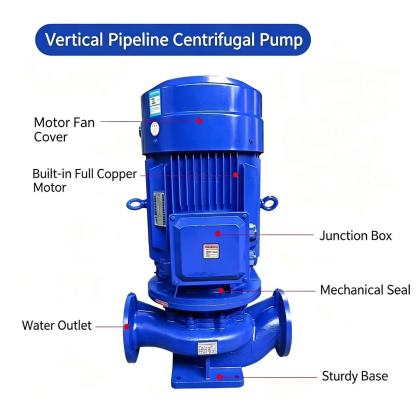
The mechanical seal is the component that most often determines whether a centrifugal pump runs reliably for years or becomes a recurring maintenance problem. In an ISG vertical pipeline centrifugal pump, the seal sits between the motor and the impeller, where the rotating shaft passes through the stationary casing. Its job is deceptively simple: prevent fluid from leaking along the shaft while allowing the shaft to turn freely. But the seal faces operate in one of the harshest environments in the pump — sliding against each other at surface speeds that can exceed 20 meters per second, lubricated only by a thin film of the process fluid, and exposed to whatever contaminants, temperatures, and chemical aggressiveness that fluid carries. When the application involves abrasive particles, high temperatures, or corrosive chemicals, a standard seal will wear out in weeks. A wear-resistant mechanical seal, properly selected and installed, can extend that interval to years.
Wear in mechanical seals takes several forms. Abrasive wear occurs when solid particles in the fluid become embedded in the softer seal face or are dragged between the faces, scratching and removing material. Adhesive wear, or galling, happens when two similar materials contact under load and material transfers from one face to the other. Chemical wear — corrosion, etching, or leaching — attacks the seal face material or the elastomers. Thermal wear occurs when insufficient lubrication causes the faces to run hot, leading to cracking, blistering, or charring of the softer face. A wear-resistant seal design addresses each of these mechanisms through material selection, face geometry, and environmental controls.
Seal Face Materials for Abrasive and High-Wear Service
The two seal faces — one rotating, one stationary — are the heart of the mechanical seal, and their material pairing is the single most important decision for wear resistance. The traditional pairing for clean water service is carbon graphite against ceramic (aluminum oxide). Carbon is self-lubricating and runs well against ceramic, but it is soft and porous. In abrasive service, particles embed in the carbon face and act like lapping compound, wearing both faces rapidly. Ceramic is hard but brittle and can crack under thermal shock or mechanical impact. For anything beyond clean water, this pairing is usually inadequate.
Silicon carbide has become the standard face material for wear-resistant seals. It is extremely hard — second only to diamond among engineering ceramics — chemically inert across a wide pH range, and dimensionally stable at high temperatures. Silicon carbide against silicon carbide is the preferred pairing for abrasive, corrosive, and high-temperature services because both faces are equally hard and neither wears preferentially. The downside is that silicon carbide is expensive and difficult to manufacture to the flatness tolerances required for seal faces — typically within one helium light band, or about 0.3 micrometers. Reaction-bonded silicon carbide is more affordable but contains free silicon, which can be attacked by strong alkalis. Sintered silicon carbide is purer and more corrosion-resistant but costs more.
Tungsten carbide is another hard face material, often used in abrasive slurry service. It is slightly less hard than silicon carbide but tougher and more resistant to mechanical shock. Tungsten carbide is typically bonded with cobalt or nickel, and the binder can be attacked by certain chemicals — cobalt-bonded tungsten carbide, for example, is vulnerable to corrosion in acidic chloride environments. Nickel-bonded tungsten carbide offers better corrosion resistance. Tungsten carbide is often paired with carbon for moderate abrasion, or with another tungsten carbide face for severe service.
For the softer face in a hard-on-soft pairing, carbon graphite grades vary significantly. Antimony-impregnated carbon is the standard general-purpose grade. Resin-impregnated carbon is denser and less porous, making it more resistant to chemical attack and blistering. Metal-impregnated carbons — with copper, bronze, or silver — improve thermal conductivity and strength but limit chemical compatibility. In abrasive service, the carbon face is often replaced entirely with a second hard face, because the carbon cannot resist particle embedding. The choice between hard-on-soft and hard-on-hard depends on the fluid: clean but corrosive fluids may work well with carbon against silicon carbide, while abrasive fluids almost always require silicon carbide against silicon carbide or tungsten carbide.
Seal Configurations: Component, Cartridge, Single, and Double
A component seal consists of individual parts — the rotating face, the stationary face, springs, and elastomers — that are assembled onto the shaft in the field. Component seals are compact and affordable, but they are sensitive to installation errors: spring compression, face squareness, and elastomer positioning all affect performance. In a vertical ISG pump, where the seal is accessed by removing the motor, component seals can be tricky to install correctly, and a mistake during assembly usually leads to immediate leakage or premature failure.
Cartridge seals solve this problem by pre-assembling all seal components into a self-contained unit that slides onto the shaft as a single piece. The spring compression is preset at the factory, the faces are protected during installation, and the seal is aligned to the shaft by the cartridge itself. Cartridge seals cost more than component seals, but they dramatically reduce installation errors and shorten maintenance time. For wear-resistant applications — where the seal may be larger, heavier, and more complex than a standard seal — cartridge construction is almost always the better choice. The reduced risk of a failed installation more than justifies the additional cost.
Single seals have one set of faces and rely on the process fluid for lubrication. They are suitable for clean, non-hazardous fluids where some leakage is acceptable. Double seals have two sets of faces with a barrier fluid between them. The inboard seal separates the process fluid from the barrier fluid, and the outboard seal separates the barrier fluid from the atmosphere. Double seals are used for hazardous, toxic, or abrasive fluids where the process fluid cannot be allowed to reach the seal faces or the atmosphere. In abrasive service, a double seal with a clean barrier fluid isolates the seal faces from the process fluid entirely, which is the most effective way to prevent abrasive wear. The barrier fluid is circulated — either by a pumping ring within the seal or by an external system — and it provides clean, cool lubrication to both sets of faces.
Tandem seals are a variation where two single seals are arranged in series with a buffer fluid between them at a pressure lower than the process pressure. Tandem seals provide a degree of containment without the full complexity of a double seal, and they are sometimes used when the primary concern is emissions control rather than abrasive wear.
Spring and Drive Mechanism Design
The spring in a mechanical seal serves two purposes: it pushes the rotating face against the stationary face to maintain contact, and it compensates for wear as the faces wear down over time. In a wear-resistant seal, the spring design must maintain consistent face loading even as the faces wear, and it must resist clogging by solids in the fluid.
Conventional single-spring seals use one large coil spring that rotates with the shaft. They are simple and provide uniform face loading, but the spring can become clogged with solids, which prevents it from compressing and causes the faces to separate. Multi-spring seals use several smaller springs distributed around the seal circumference. They provide more uniform face loading and are less affected by clogging because the smaller springs are less likely to trap large particles. However, multi-spring seals are more complex and the springs can be attacked by corrosive fluids if not properly protected.
Bellows seals use a metal or elastomer bellows instead of a spring to provide face loading. Metal bellows seals are particularly suited to high-temperature and corrosive service because the bellows can be made from Hastelloy or other high-alloy materials, and there are no spring cavities to clog. Elastomer bellows seals are simpler and more affordable but limited to moderate temperatures and compatible fluids. In abrasive service, bellows seals are often preferred because the bellows design is inherently resistant to clogging — there is no spring to pack with solids.
The drive mechanism — how the rotating face is connected to the shaft — also matters for wear resistance. Set screws can dig into the shaft and create stress concentrations, and they can loosen under vibration. Keyed drives or taper-lock connections provide more positive engagement. In a vertical pump, the seal's weight acts along the shaft, and the drive mechanism must support that weight without slipping. Some cartridge seals use a split collar or a clamp ring that grips the shaft uniformly, avoiding the localized damage caused by set screws.
Elastomers and Secondary Seals in Wear-Resistant Applications
While the seal faces get most of the attention, the elastomers — O-rings, gaskets, and bellows — are equally critical to seal reliability. In abrasive service, elastomers can be damaged by particle intrusion, and in corrosive service, they can swell, harden, or disintegrate. The elastomer must be compatible with the process fluid, the operating temperature, and any cleaning or flushing chemicals that may pass through the pump.
Nitrile (Buna-N) is the standard elastomer for water and oil service, rated to roughly 120 degrees Celsius. It is affordable and widely available but has limited chemical resistance. EPDM resists hot water, steam, ketones, and many acids, and it is commonly used in HVAC and hot-water circulating pumps. Fluorocarbon (Viton) offers broad chemical resistance and higher temperature capability — up to 200 degrees Celsius in some grades — but it is attacked by steam, hot water, and certain solvents. Perfluoroelastomers (FFKM) offer near-universal chemical resistance and temperature capability up to 300 degrees Celsius, but they are expensive and typically reserved for the most demanding chemical applications.
In abrasive service, the elastomer can be damaged by particles that work their way between the O-ring and its groove. Once the O-ring surface is scored, it loses its ability to seal, and leakage follows. Protective devices — such as Teflon envelopes or back-up rings — can shield the elastomer from particle damage. Some wear-resistant seals use PTFE wedge gaskets instead of O-rings for the secondary seal, because PTFE is more resistant to abrasion and chemical attack. PTFE is not as elastic as an elastomer, however, and it requires careful design to maintain sealing force over temperature cycles.
The seal environment — the space around the seal faces and elastomers — can be controlled to reduce wear. A flush plan that injects clean fluid into the seal chamber flushes away abrasive particles and cools the seal. A throat bushing restricts the flow of process fluid into the seal chamber, maintaining a clean environment around the faces. A quench connection on the atmospheric side of the seal provides a gentle flow of clean water or steam to prevent crystallization and keep the elastomers cool. These environmental controls are not substitutes for proper material selection, but they extend the life of any seal by reducing the severity of the conditions it must endure.
Installation, Alignment, and Startup Practices
Even the best wear-resistant seal will fail prematurely if it is installed incorrectly. In a vertical ISG pump, the seal is typically accessed by removing the motor and lifting the rotating assembly. The shaft must be clean and free of burrs, corrosion, or old seal material before the new seal is installed. Any scratch or nick on the shaft at the seal running surface can cause leakage and wear. A shaft sleeve — a replaceable cylinder of stainless steel or ceramic-coated material — is often used to protect the shaft from seal wear and to provide a smooth, consistent surface for the seal elastomers.
Face squareness is critical. The stationary seal face must be perpendicular to the shaft axis within tight tolerances — typically within 0.05 millimeters of total indicator reading. If the face is cocked, the seal faces will not make uniform contact, and localized high loading will cause rapid wear. In a cartridge seal, squareness is ensured by the cartridge design, but the pump casing must still be clean and the seal must be seated properly against the casing gasket. In a component seal, squareness must be verified during installation with a dial indicator.
Startup procedures directly affect seal life. Before starting the pump, the seal chamber must be filled with fluid and all air vented. A dry start — even for a few seconds — can destroy the seal faces because there is no fluid film to lubricate and cool them. The pump should be started with the discharge valve throttled to reduce the initial pressure differential across the seal, then gradually brought to operating conditions. For double seals, the barrier fluid system must be pressurized and circulating before the pump is started.
After startup, the seal should be monitored for leakage. A small amount of weepage — a few drops per minute — is normal for a single mechanical seal and helps lubricate the faces. Excessive leakage, discoloration, or a steady stream indicates a problem. The seal should also be monitored for temperature; an infrared thermometer or a thermocouple on the seal chamber can detect overheating before it causes face damage. Vibration monitoring is also valuable, because excessive vibration — from misalignment, imbalance, or cavitation — accelerates seal wear by causing the faces to separate and re-contact repeatedly.
Selecting the Right Wear-Resistant Seal for the Application
The process of selecting a wear-resistant mechanical seal begins with a clear understanding of the application. What is the fluid, and what are its contaminants? What is the temperature range? What is the pressure differential across the seal? What is the shaft speed and diameter? What level of leakage is acceptable, and is the fluid hazardous? These questions determine whether a single seal is sufficient or a double seal is required, whether a component seal will work or a cartridge seal is needed, and which face materials and elastomers are appropriate.
For clean but corrosive fluids, a single cartridge seal with silicon carbide against resin-impregnated carbon and compatible elastomers is often adequate. For mildly abrasive fluids — such as river water with suspended silt — a single seal with silicon carbide against silicon carbide faces and a flush plan to keep particles away from the faces may be sufficient. For heavily abrasive fluids — slurries, mine water, wastewater with grit — a double seal with a clean barrier fluid is usually the only reliable configuration, because the process fluid cannot be allowed to reach the seal faces at all.
Temperature is another decisive factor. Above roughly 120 degrees Celsius, standard elastomers begin to degrade, and metal bellows seals with high-temperature alloys may be required. Above 180 degrees Celsius, even fluorocarbon elastomers are marginal, and perfluoroelastomers or metal bellows designs become necessary. High temperatures also increase the risk of face cracking from thermal shock, especially for ceramic faces, and may require a flush plan to cool the seal chamber.
The pump's operating profile matters too. A pump that runs continuously at its best efficiency point is gentle on seals. A pump that cycles frequently, operates at low flow, or experiences cavitation is hard on seals because the faces are repeatedly subjected to pressure transients and insufficient lubrication. In these services, a more robust seal — with harder faces, a stronger spring design, and environmental controls — is justified even if the fluid itself is relatively benign.
The wear-resistant mechanical seal in an ISG vertical pipeline centrifugal pump is a system of interacting choices: face materials that resist the specific wear mechanism, a seal configuration that matches the hazard level, elastomers compatible with the fluid and temperature, environmental controls that reduce the severity of the seal environment, and installation and startup practices that protect the seal during its most vulnerable period. No single seal is best for every application, but by matching the seal design to the service conditions, the engineer can achieve seal life measured in years rather than months.


