In coal washing plant operations, correctly matching motor power to the filter press feed pump is a critical engineering decision that directly impacts system efficiency, operational cost, and long-term equipment reliability. An undersized motor will overheat and fail prematurely under the demanding conditions of high-density slurry feeding, while an oversized unit wastes energy, increases capital expense, and can lead to unstable operation at low load points. For facilities processing abrasive coal slurry around the clock, precise motor sizing ensures the entire dewatering circuit runs smoothly, maintains stable pressure output, and minimizes unexpected electrical or mechanical downtime.
Calculating power demand based on slurry density and pressure profile
The motor power requirement is not simply a function of pump size; it must account for the specific characteristics of the coal slurry being processed. Key factors include the slurry's specific gravity, which is often significantly higher than water due to high solids content, and the full pressure cycle of the filter press. The power calculation must cover the entire operational range: from the initial low-pressure, high-flow phase needed to quickly fill the filter chambers, through the rising pressure phase as the cake forms, up to the final high-pressure, low-flow compression stage. Engineers typically add a service factor to this base calculation to account for the additional torque required to handle the abrasive nature of coal slurry and potential temporary increases in viscosity, ensuring the motor has sufficient reserve power to handle real-world variations without tripping.
Considering voltage, starting method, and ambient conditions
Beyond raw horsepower, several other electrical and environmental factors influence motor selection for a coal washing plant. The available plant voltage (e.g., 380V, 415V, 660V) determines the motor's winding configuration and starting characteristics. For high-inertia systems like a feed pump starting against a filled pipeline, a soft starter or variable frequency drive (VFD) is often recommended to reduce inrush current and mechanical shock, which also affects the motor's thermal capacity requirements. Furthermore, the often harsh, dusty, and sometimes humid environment of a coal processing area necessitates selecting a motor with an appropriate ingress protection (IP) rating and insulation class (e.g., F or H) to ensure reliable operation despite coal dust and potential moisture exposure.
Matching drive train components for efficient power transmission
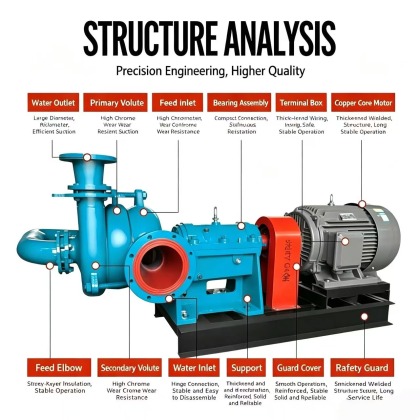
The motor is only one part of the drive train. Its power must be efficiently transmitted to the pump shaft through a correctly selected coupling or belt drive system. Direct coupling is common for precise alignment and efficiency, but it requires meticulous installation to avoid imposing axial or radial loads on the pump bearings. The selection of the coupling must also accommodate minor shaft misalignment and dampen vibrations to protect both the motor and pump bearings. Proper alignment during installation and as part of routine maintenance is non-negotiable; misalignment is a primary cause of premature bearing failure, excessive vibration, and wasted energy, which can negate the benefits of a perfectly sized motor.


