Internal flow channel design is one of the most critical engineering disciplines for ISG vertical pipeline centrifugal pumps, as it defines how efficiently mechanical energy from the rotating shaft is transferred into fluid pressure and flow momentum. Every geometric detail inside these wetted flow paths directly impacts real-world performance across variable operating conditions, making it a core focus for hydraulic engineers and system designers working on reliable inline pumping solutions.
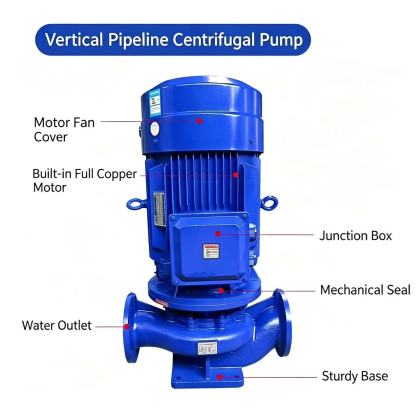
Suction side flow path conditioning before impeller entry
The flow section between the pump suction flange and the impeller eye is engineered with a continuous, streamlined profile that eliminates sharp corners, sudden diameter changes, and dead zones that could disrupt uniform fluid delivery to the impeller. This design ensures that fluid approaches the blade leading edges with nearly identical velocity across the entire inlet area, reducing uneven loading on individual blades and minimizing the risk of localized low-pressure zones that could initiate cavitation. The gradual transition also suppresses unwanted pre-swirl that would otherwise reduce effective flow capacity and create unnecessary hydraulic loss before the fluid even enters the impeller passages. Even when the pump operates at flow rates well below its nominal design point, this suction side geometry helps maintain stable flow direction and avoids the severe flow separation that often leads to noise and vibration.
Impeller inter-blade passage hydraulic shaping
Each individual flow channel formed between two adjacent impeller blades is profiled through iterative hydraulic simulation and physical testing to balance flow acceleration, pressure buildup, and friction loss from the inlet to the outlet of the blade. The channel width follows a carefully calculated non-linear curve that expands smoothly without abrupt dimensional jumps, preventing localized flow detachment, eddy formation, and energy dissipation that would lower overall efficiency. Both the hub and shroud surfaces of the impeller are machined or cast to a continuous smooth contour that guides fluid along the intended streamline path, avoiding sudden directional changes that would generate unnecessary turbulence. This precise profiling ensures that the maximum possible portion of the impeller’s rotational energy is imparted to the fluid as useful pressure rather than being wasted in chaotic internal flow motion.
Volute flow collection and discharge diffusion structure
The volute casing surrounding the impute features a progressively growing cross-sectional area that matches the volume of fluid discharged from the impeller at each angular position, collecting flow evenly around the impeller perimeter and directing it toward the discharge connection. This gradual expansion converts the high kinetic energy of fluid leaving the impeller into stable static pressure with minimal shock loss, while balancing radial forces acting on the pump shaft to reduce bearing load during continuous operation. The final diffusion section leading to the discharge flange maintains a mild, controlled expansion angle that prevents flow separation on the inner casing walls, further improving pressure recovery and reducing overall system resistance. This design performs consistently across a wide operating range, avoiding the sharp efficiency drop and rising vibration that poorly shaped volutes exhibit when operating far from their best efficiency point.
Flow channel surface finish and geometric alignment control
All wetted surfaces inside the impeller, volute, and intermediate transition sections are processed to achieve a consistently low surface roughness, reducing frictional drag between the fluid and metal walls that would otherwise erode efficiency over thousands of operating hours. Strict manufacturing tolerances are enforced at all mating joints between flow path components to eliminate misalignment steps that would break smooth flow lines and create local eddy currents at connection points. This level of precision helps preserve the original hydraulic design performance throughout the pump’s service life, even when the unit handles media containing low concentrations of fine abrasive particles that would otherwise cause uneven erosion in high-velocity zones.


