Proper installation dimension control is one of the most critical factors to ensure long-term stable operation of inline centrifugal pump systems. Even minor misalignment or incorrect spacing can introduce unnecessary pipe stress, increase vibration levels, and shorten the service life of bearings and shaft seals. Every dimension on site must be measured and verified before any fastening work begins, so that the final assembly can match the design intent and avoid hidden risks that only appear after weeks or months of continuous operation.
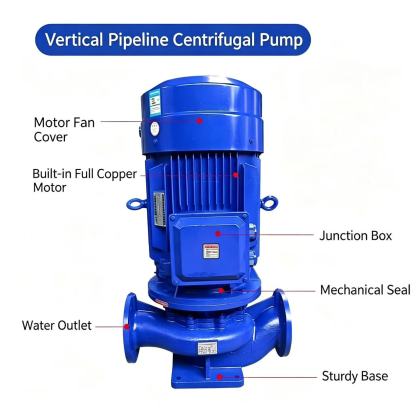
Foundation and mounting surface dimension control
The first dimension to confirm is the flatness of the foundation surface where the pump unit will be positioned. The supporting area must be large enough to distribute the total weight evenly, and the surface flatness should be kept within a narrow tolerance range to prevent tilting after installation. Anchor bolt positions must be laid out according to the overall footprint of the pump and motor assembly, with enough clearance around each bolt hole to allow slight positional adjustment during alignment. The vertical distance from the foundation top surface to the pump centerline should also be checked against the system piping layout, so that no additional vertical stress is transferred to the pump flanges once all pipe connections are completed. This step helps maintain consistent shaft alignment over time and reduces the possibility of structure settlement affecting operating accuracy.
Suction and discharge piping dimension coordination
Both suction and discharge pipes must be arranged so that their centerlines perfectly match the pump flange centerlines without any forced pulling or pushing during connection. The straight pipe length immediately before the suction flange should follow standard hydraulic practice to ensure uniform flow distribution into the impeller, which helps avoid uneven pressure distribution that could lead to cavitation or efficiency loss. Each pipe section near the pump must be supported independently, so that the weight of the piping does not rest on the pump casing itself. Flange parallelism and bolt hole alignment are also part of dimension control, as angular misalignment between pipe flange and pump flange can create hidden stress that gradually deforms the pump casing and causes seal leakage after prolonged operation.
Shaft and coupling alignment dimension verification
Even though many close-coupled vertical models have the impeller mounted directly on the motor extension shaft, it is still necessary to check the concentricity and perpendicularity of all rotating components within the allowed dimension range. For units equipped with separate coupling elements, the gap between two coupling halves must be measured at multiple angular positions to ensure uniform clearance, and the radial offset must be kept within very small values specified by industrial standards. These dimension checks should be carried out after both piping and foundation fasteners are fully tightened, because stress released during the final tightening process can slightly shift the relative position between pump and motor. Correct alignment dimensions directly reduce operating vibration, lower bearing temperature rise, and help the entire unit run smoothly under full load for extended periods.


